How Retrievy Transforms Static Documents into Intelligent Knowledge Bases
In the era of Generative AI, we’ve all experienced the "Hallucination Gap." You ask a powerful LLM (Large Language Model) a specific question about your 50-page internal report, and it responds with a confident, yet entirely fabricated, answer.
This happens because standard AI models are trained on general internet data, not your specific, private data. To bridge this gap, a revolutionary architecture has emerged: RAG (Retrieval-Augmented Generation).
At Retrievy, RAG is the heartbeat of our platform. In this guide, we’ll dive deep into what RAG is, how it works, and why it’s the secret sauce for high-stakes information retrieval.
What is RAG (Retrieval-Augmented Generation)?
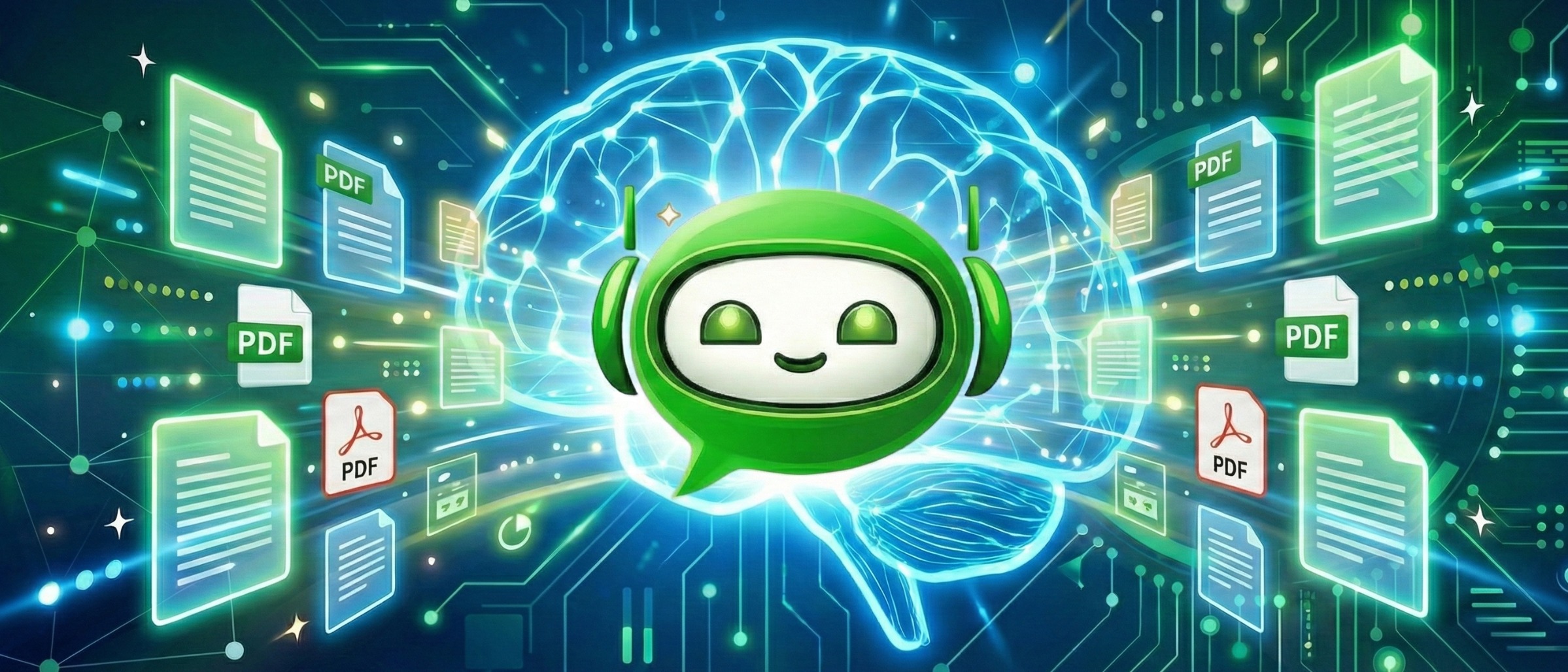
Retrieval-Augmented Generation (RAG) is an AI framework that retrieves relevant information from a specific, external data source (like your PDFs, DOCX, or TXT files) before generating a response.
Think of a standard AI as a student taking an exam from memory. They are smart, but they might misremember facts. RAG is that same student taking an "open-book" exam. Before answering, the student looks at the textbook, finds the exact paragraph, and then synthesizes the answer.
Why RAG is Better Than Standard AI:
Grounding in Reality: Responses are based strictly on provided data, drastically reducing "hallucinations."
Up-to-Date Information: You don't need to retrain the AI model; you just update the documents in your Knowledge Hub.
Source Transparency: Because the AI "reads" a specific section, it can point you to the exact page and line it used.
How RAG Works: A Deep Dive into the Retrievy Workflow
Understanding RAG requires looking under the hood at how data moves from a static file to a conversational insight. At Retrievy, we’ve optimized this into a high-precision pipeline:
1. Data Ingestion & Chunking
When you upload a document to Retrievy, the system doesn't just "read" it like a human. It performs Deep Ingestion. We break the text into smaller, manageable "chunks." We also filter out "noise" like headers, footers, and page numbers to ensure the AI only focuses on the "gold"—the actual content.
2. The Power of Vector Embeddings
This is where the magic happens. Each text chunk is converted into a Vector Embedding—a long string of numbers that represents the semantic meaning of the text.
Keyword Search (Old way): Looks for the exact word "Revenue."
Semantic Search (Retrievy way): Understands that "Income," "Earnings," and "Top-line growth" are related concepts, even if the word "Revenue" isn't present.
3. The Retrieval Step
When you ask, "What were the key risks mentioned in the Q3 audit?", Retrievy converts your question into a vector and searches your Knowledge Hub for the chunks with the most similar mathematical values. In milliseconds, it retrieves the most relevant paragraphs from your files.
4. Contextual Generation (The "Augmentation")
The system then sends a "Prompt" to the LLM that looks like this:
"Using ONLY the following excerpts from the Q3_Audit.pdf, answer this question: [User Question]. If the answer isn't in the text, say you don't know."
The AI then generates a natural-sounding response based only on that evidence.
Why Professionals Choose Retrievy for RAG
While many tools claim to offer "Chat with PDF," Retrievy is built for Precision & Logic.
1. Verified Truth with Citations
Trust, but verify. Every answer generated by Retrievy includes Source Link Citations. One click takes you to the exact page and paragraph used as evidence. This is critical for legal, financial, and medical research where "close enough" isn't good enough.
2. Handling High-Stakes Complexity
Traditional search fails when you have 50+ research papers or 200-page lease agreements. Retrievy’s advanced RAG engine maintains context across multiple files, allowing you to compare data points across your entire library simultaneously.
3. Enterprise-Grade Security
Standard AI models often use your inputs to train their public data. At Retrievy, we use Team-Level Isolation. Your "Secret Sauce" stays secret. Your documents are stored in private silos, encrypted and protected.
Real-World Applications: RAG in Action
Legal Counsel: Instantly extract risky liability clauses across hundreds of contracts.
Investment Analysts: Compare quarterly earnings from the last 5 years to pull YOY variations automatically.
Security Engineers: Feed in post-mortems and security logs to identify recurring patterns without manual scanning.
Academia: Synthesize a literature review from a folder of 50 research papers in seconds.
Conclusion: Stop Digging, Start Knowing
The transition from "Keyword Search" to "Semantic RAG Retrieval" is the biggest leap in productivity since the invention of the search engine. By using Retrievy, you aren't just chatting with a bot; you are deploying a precision instrument for high-stakes information retrieval.
Ready to experience the power of RAG?
Upload your first document to Retrievy.com and turn your data into decisions today.