Active Directory Security Audit Tool: From Configured to Applied
An Active Directory security audit tool can prove a GPO exists. It cannot, on its own, prove the policy is being applied to the machines that need it. That gap is where most domains quietly stop being defensible, regardless of how clean the audit looks.

Three GPOs claim to enforce your password policy. Two of them are linked to the wrong OU, and the third is filtered by a security group that no longer exists. The compliance audit reports password enforcement as configured. Your domain has had no enforced password policy on its production workstations for eighteen months.
This is not a contrived scenario. It is the third or fourth most common finding I have seen in real Active Directory environments that have been audited annually and scored well.
An Active Directory security audit tool, by design, reads what the directory says. What it cannot read on its own is whether what the directory says actually matches what is happening on the machines.
Configured Is the Easy Part
The standard delivery of an Active Directory security audit tool is now well understood. It connects to the directory with read-only credentials, enumerates the domains, OUs, users, groups, GPOs, fine-grained password policies, delegations, trust relationships, and the dozens of operational artifacts that frameworks like CIS, NIST 800-53, and the Microsoft Security Compliance Toolkit care about. It produces a per-domain report and a per-control map. It does this on a schedule and stores snapshots, so you can diff one week against another.
This part of the category has matured. If a tool cannot read your directory state, map it against the major framework controls, and surface drift between snapshots, it is not really an Active Directory security audit tool. It is a directory exporter.
What the category as a whole has not solved, and what almost every audit I have seen quietly leaves on the table, is the second-order question: are the policies the audit just read actually applied to the systems where they matter.
The Audit Tool's Honest Limit
A Group Policy Object is not a configuration. It is a wish.
The GPO is configured at the directory level. Whether it ever reaches a given machine depends on three independent variables. Where the GPO is linked, and which OU is in scope for that link. Whether the security filter on the link permits the target. Whether any WMI filter attached to the link evaluates true on the target machine. Every one of those variables can be edited independently of the others, and frequently is, by different people, at different times, for different reasons.
This is why the three-GPO scenario at the top is not an edge case. A domain that has run for five years will have accumulated GPOs that were created in good faith, modified during incidents, partially deprecated, partially forgotten. The directory still lists them. The audit tool dutifully reads them and gives you a control map showing the password policy is configured. The machines, however, are a different story.
A senior administrator with enough time can answer the application question for one machine at a time by running gpresult /h and reading the output. Doing it across ten thousand workstations, every day, against a moving baseline of GPO edits, OU restructures, and group-membership changes, is not feasible for a human. It is also not what most Active Directory security audit tools attempt.
From Inventory to Verification
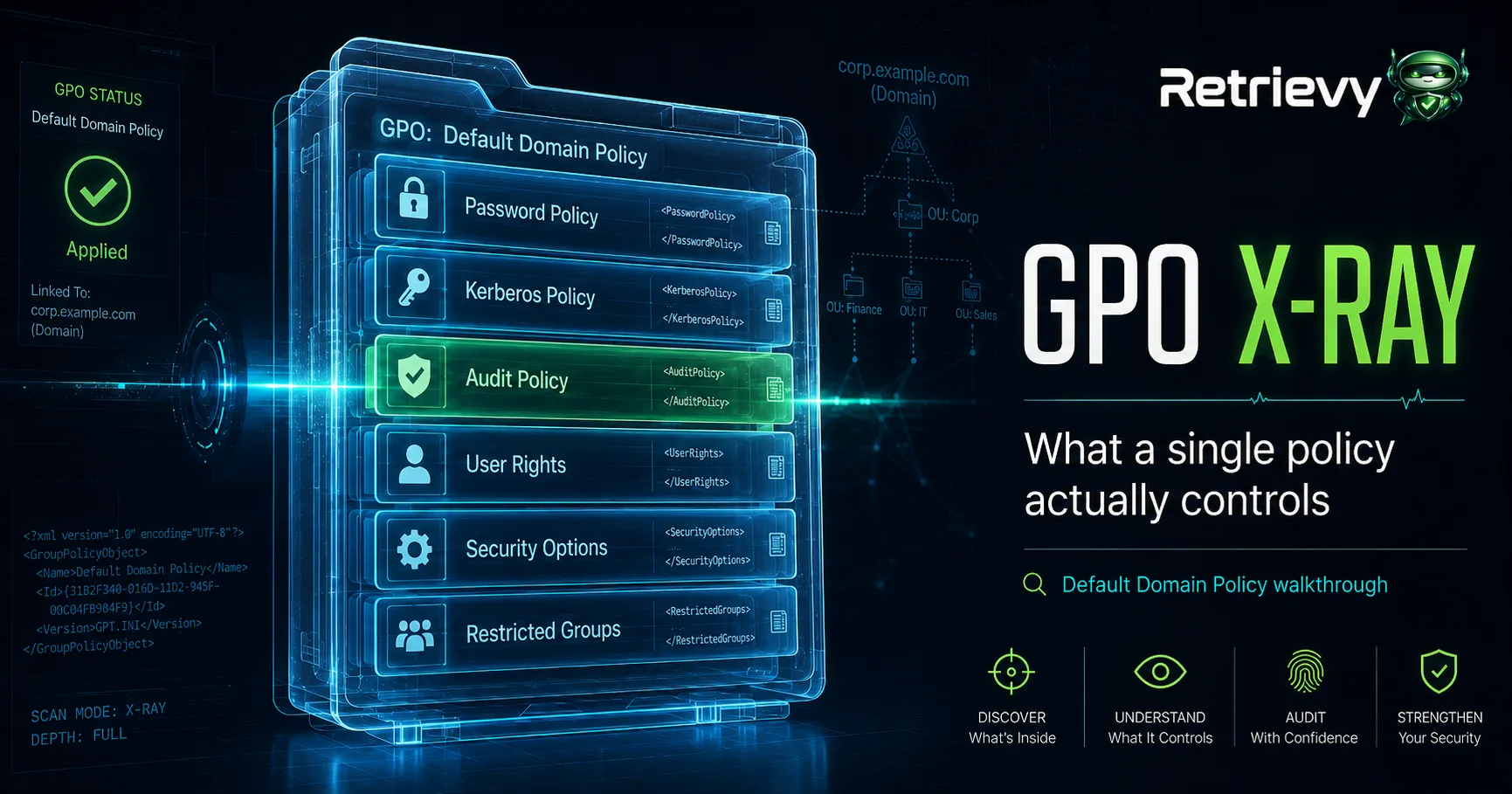
GPO X-Ray, the second screen this category has been missing, works off the same directory snapshot the audit ran on, so there is no second scan, no second credential, no extra weight on the domain controllers.
For every GPO, it answers three questions the audit cannot.
It traces every link, every OU in scope, every security filter, every WMI filter, and computes the effective set of machines and users the GPO will actually apply to. Not "the GPO exists." Not "the GPO is enabled." The set of objects RSoP would calculate, surfaced in advance, in aggregate, on every GPO in the domain.
It surfaces the GPOs that look configured but in practice apply to nothing. The link is broken. The security filter excludes everyone. The WMI filter is malformed. The GPO is enabled and is doing nothing. A compliance audit will not flag it, because the GPO exists and contains the correct settings. The reality is that no machine in your environment is receiving them.
It surfaces the inverse. Machines and users that are not receiving the policies frameworks assume are universal. The workstation that does not get the password policy GPO because its OU was moved during a reorganization three years ago and the GPO was never relinked. The privileged account in a group that quietly escaped the conditional access policy. The new server in a flat OU that no GPO has ever scoped.
These are not framework violations. They are gaps in the application surface frameworks do not measure. They are also, in practical terms, where most domain compromises that survived a clean audit got their start.
The One-Domain Test
The fastest way to tell whether the Active Directory security audit tool you are considering can answer the application question is to take a single domain controller, connect it, and let the first scan finish. Then ask the screen three things.
For your password policy, can the tool tell me, by hostname, which workstations in production are not currently receiving it. For your account lockout policy, can the tool show me which users would be exempt because of a security filter or a WMI clause. For any GPO in the domain, can the tool draw the actual application boundary, not the assumed one.
If all three answers are yes, you have a tool that does what its name promises. It audits the directory, and it verifies what is being enforced on the machines. GPO X-Ray is the bar Retrievy set for itself on this surface, and the three questions above are the cheapest way to see whether your current tool clears it.
If any of the three answers is no, you have a tool that produces a catalog of what your directory wishes to be. The catalog is real, and it is useful. It is also not the same as a guarantee that the directory's wishes are being honored.